 Switchyard
Read their terms of service. Then read ours.
Every AI notes vendor will sign a BAA. Almost every one of them also reserves the right to keep and use a de-identified version of your session content — and de-identified data is not protected by HIPAA at all. That is the gap the BAA does not close.
Switchyard has no such clause, because there is no transfer. The models are inside the app, and the app runs on your Mac. No account, no server, nothing for anyone to retain.
There is no microphone.
Not “we delete the audio.” The app has no microphone permission and no audio capture anywhere in it. You dictate or type thirty seconds of your own notes after a session — the way you already do — and it organizes what you said into S, O, A, and P.
Your client is never recorded
So you never have to ask them, never have to explain a vendor, and never have to manage a standalone recording consent form. The conversation simply does not come up.
There is no transcript to subpoena
A verbatim session recording is a discoverable object that did not exist before someone chose to make one. What exists here is what has always existed: your own contemporaneous summary, in your own words.
Eleven tools for the paperwork a practice actually gets.
Pick a tool, drop in a document or your notes, review what it found, save it. Everything is editable before it is written, and the tools transcribe what the page says instead of paraphrasing it into error. A value the document does not state comes back blank, not guessed.
Notes you author
Post-session dictation into a SOAP draft. Intake material into SOAP, DAP, or BIRP. Treatment plan item lists.
Documents that arrive
Records requests and subpoena triage. EOB and denial letters. Authorization logging. Superbill field extraction. ROI releases. Attendance and contact logs.
Ask
Plain-language questions answered only from your own saved records, with every answer cited back to the file it came from. Useful when you need what you wrote eight months ago.
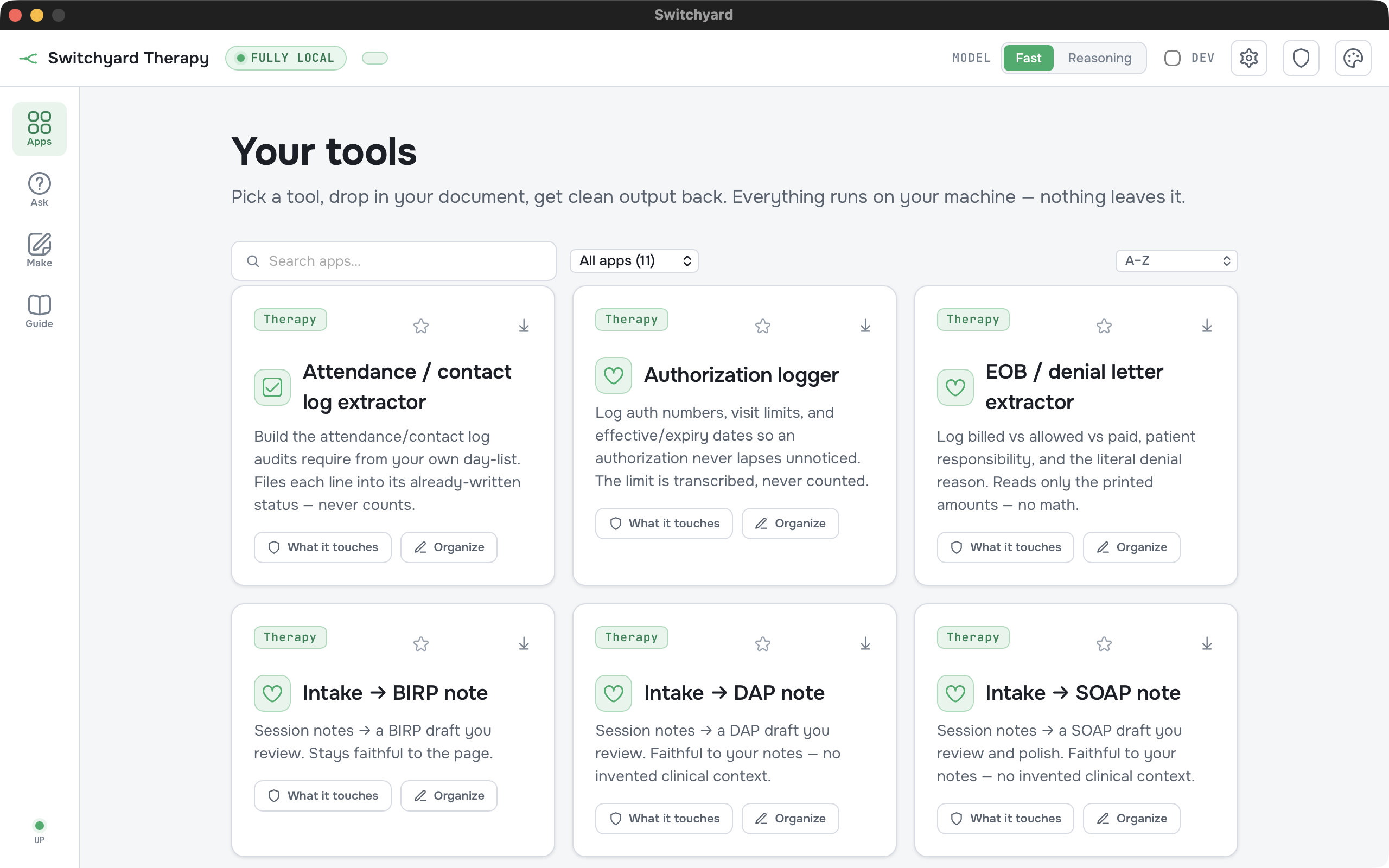
Switchyard Therapy opens populated. There is no toolkit to pick and nothing to configure.
Ninety seconds, and you never have to trust us again.
Every product in this category says it respects your clients' privacy. This is the only claim on the page you can check yourself, and we would rather you did than take our word for it.
- Turn off Wi-Fi. Unplug ethernet too. Confirm you are offline by loading any web page and watching it fail.
- Write a full day of notes. Drop in documents, run the tools, ask questions of your own records, export a file. All of it works, at full quality, with no network at all.
- Turn the network back on and watch the counter. The app shows the bytes it has sent. It reads zero and keeps reading zero, because there is nowhere for it to send anything.
- The harder version: put Little Snitch or LuLu in front of it and block the app outright. Nothing changes.
Since you will check the entitlements
The app ships with two network entitlements, and both exist because it talks to itself. Switchyard's interface is served by a small web server running inside the app bundle, so it needs network.server to open a port on 127.0.0.1 and network.client to connect back to that same port. A sandboxed app needs client permission even to reach its own loopback address.
And the downloader
There is model-download code in the repository, and in the shipping app it cannot run. It is gated behind an environment flag that only a setup script sets, and the server as the app launches it can never reach that path. Nothing you click inside Switchyard downloads anything.
This app is not “HIPAA compliant.” No app is.
Compliance describes how a practice works, not software someone installed, and any vendor telling you otherwise is selling you something. Here is the factual version instead: because no third party ever receives the document, there is no business associate to contract with, no retention terms to read, no subprocessor to disclose, and no vendor in your breach-notification chain.
Your own obligations are unchanged. What is removed is the party you could not audit.
Therapy is the one built for a clinical practice.
The focused editions carry only their own profession's tools. Complete carries all of them and adds automation — folder watchers, schedules, and goals you hand off — which is a practice-scale feature rather than a solo one.
Switchyard Therapy
Session notes into a clean draft, dates off an authorization letter, and a way to find what you wrote about a client eight months ago.
- SOAP, DAP, and BIRP drafts
- Treatment plans and authorizations
- Superbills, EOBs, denial letters
- Records requests and attendance logs
Switchyard Legal
A contract read down to its dates and obligations, and a way to find what you wrote on a matter last spring.
- Contract and lease abstracts
- Key dates and deadlines, as written
- Demand letters and discovery shells
- Medical chronologies, case captions
Switchyard GovCon
Every shall-statement out of a PWS, Section L and M into a compliance matrix, CLINs logged, Section K checked.
- Shall-statement shred, verbatim
- Section L and M outlines
- CLIN structures, PWS and CDRLs
- Section K reps, wage determinations
Switchyard Complete
All four toolkits, and the part the focused editions do not carry: work that runs without you standing over it.
- Every toolkit above, plus General
- Automate — point a tool at a folder
- Hand off a goal in plain words
- Build your own tools on a canvas
One-time purchase, all future updates included, no subscription. Requires an Apple silicon Mac running macOS 12 or later. The download is about 6 GB, because the models are in it.
Group practices usually want an hour with someone first.
The app installs and runs without help. What is worth an hour is the rest: which tools fit the way your clinicians already write, where the records folder lives, and getting a whole practice on one habit instead of six. We do that directly, for individuals and for practices.